Showing posts with label Kid. Show all posts

November 12, 2017

The Magic School Bus Rides Again

Hey buddy. Right now, you’re probably thinking I’m insane for writing this blog post to you. Who writes a blog post about a Netflix show to their future kid? Well, I am. Not just because it’s assigned, but because it presented a fun opportunity to let you know about one of my favorite childhood series.

Back in the olden days when I was a kid (yes, I was a kid at one point), your aunt Abby and I were obsessed with a book series called The Magic School Bus. Pretty much every late 90s kid has at least heard of this series, so I was understandably excited to see Netflix giving it a new life. Watching this show with Abby was such a distinct memory from my childhood. We still own the original set of books that we bought, and we’ve read them countless times. Even ten years after their publication, your uncle Avery loved them just as much as did.

Because these books are still so near and dear to my heart, I had very high expectations for the Netflix revamp. I almost didn’t want to watch, because I was worried about ruining my childhood memory of the show. However, I just had to know whether or not this new show would be worthy of sharing with you sometime down the road. Obviously, you’ll be forced to watch the original series as soon as you’re old enough to comprehend it, but this could be a nice addition to the collection.

As I was learning about the plot of The Magic School Bus Rides Again, I learned that they replaced the lovable Ms. Frizzle with her younger sister, also Ms. Frizzle, who had recently become a teacher. I wouldn’t say I was upset about this change, but I was definitely a little worried about how such a big change to the plot would pan out. But I found myself really enjoying this twist in the story. It helped me justify this new show as more than just a “remake”. With a brand new teacher, but similar episodes and main characters (mainly students), it felt like a continuation of the show I once loved.

Another thing that really struck me about the show was the actual animation of it. I’ve inserted a picture from the original show (which premiered in 2001) and the new Netflix remake.
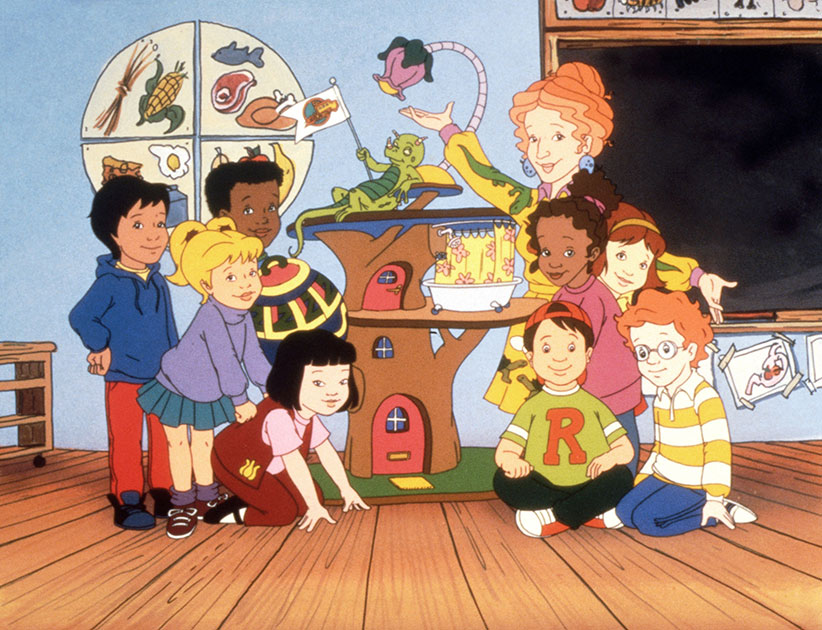
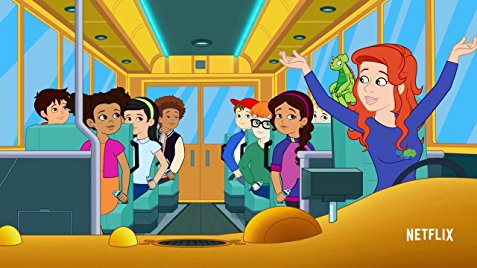

As you can see, the animation and coloring of the two shows are very different. Because the original was so ingrained into my memory, this was definitely a little jarring for me. But the longer that I look at it, I really do like the aesthetic of Netflix’s adaptation. It’s obviously not nearly as 90s grunge as the original Magic School Bus, but I have to say it’s more attractive. Additionally, it closely resembles a lot of the popular children’s shows today, which makes sense considering the market that Netflix is targeting. Unfortunately, I guess that market is actual children and not 20 year old college students looking to relive the past.

Overall, I enjoyed this updated version of The Magic School Bus. I can see myself watching it with you, my future kiddo. It’s something we can bond over, assuming you love it as much as I do.

September 10, 2017

Puss in Book: Trapped in an Epic Tale

One more week of thinking what to see on Netflix, and I still have no idea to choose. There are many comments which suggest me to watch House of Card, White Collar, etc. However, because I am a fan of the cartoon, especially I like Puss in Boots, another movie which relates to Puss is my first choice. Therefore, Puss in Book: Trapped in an Epic Tale is my movie I choose this week to write about.

Puss in Book: Trapped in an Epic Tale is an extra story following the series The Adventures of Puss in Boots. Unlike the series, this movie has a special detail: a storyteller. Books are better than movies in some ways. When we read a book, each word describing the character as well as the scene help us to have the clearest images. By using our imagination, the images will be more beautiful,  more lively, and may be more fiction. Furthermore, a storytelling in every book helps us to understand easily the meaning of the plot. However, in the movie Puss in Book: Trapped in an Epic Tale, a storyteller plays an important role in explaining what happens during the movie. He helps to have a clear purpose of what the movie is about. Without him, the watchers may be struggled a little bit in figuring out why Puss was trapped inside an Epic Tales.

Timing is another important factor which makes the movie become better. Following the plot, Puss has to find the evil Queen in order to break the spell which curses the lady. It will take Puss many months to find out the castle of the Queen. However, with the shortcut technique, a long journey which takes a few month only last a few second in the movie. Furthermore, the movie is based on some famous epic tales which are very long, and some of them take a movie to tell a whole story. In Puss in Book: Trapped in an Epic Tale with five or ten minutes each tale, the movie can easily tell several stories at once. Shortcut technique may be dangerous because if the filmmakers use it too much, it is very difficult to the audience to understand the movie. However, the filmmaker in Puss in Boots has been clever use of this technique so that the audiences could still understand the content accurately, although it includes many epic tales.

In the series The Adventures of Puss in Boots, music and visual involve a crucial role in depicting the meaning of the scene. Once again, the effectiveness of those elements continues to be promoted in this movie. After the kiss between Puss and the Queen, a romantic music is emerging. They are flying into the sky with pink clouds behind them and the hearts of love flying through them. A romantic scene is built up helps the audience to understand that they are in love with each other. At the end of the movie, the storyteller is actually Puss old enemy, a tiny white mouse. A fight between them happens. To make the battle more dramatic and repetitive,  the filmmakers make use of the intense music. With the drum and the horn, the audience will get excited to the battle and want to watch till the end.

September 3, 2017

Mise-en-Scene in Cartoons?

Dear Barton,
For my blog post today, I decided to try to replicate the activity that we did for Mise-en-Scene. I found this rather challenging. In class, we used stills that you had selected. The one aspect that was the same with every still you choose was that they were all live action shows with actors, props, and costumes. We didn’t broach the topic of can Mise-en-Scene be applied to a cartoon or animation. In LEGO Elves: Secrets of Elvendale, the artists have a lot less they need to manipulate to get their point across. I choose a random still where it looks as if a dark green haired male elf is talking to two human girls. The girls seem like they might be siblings, one bigger than the other but the same hair color. A purple haired female elf looks like she wants to speak with the dark green haired one. And the bodies of three other elves are visible, one red and orange with tanned skin female, one dark blue and light blue with light skin female, and one green and brown with light skin male. The female with tanned skin has an outfit that seems based off of fire. The blue one probably water and the green one probably earth. The purple haired girl is in all purple which leads me to believe that she is in some sort of group with the others. The dark green haired male elf previously mentioned is wearing mostly brown. The red, blue, and green ones are all standing next to one another. I would guess just because of the general nature of fantasy that they have powers that involve the elements previously mentioned. The dark green haired male might be a leader, friend, or there for helping everything go smoothly. The two human girls are both wearing stripes with their backs to the audience perhaps to show the dark green haired elf speaking or the purple one talking to him. The ground has mostly grass and some rocks but somehow we get the feeling it is set in the forest.
So after watching the episode, a good number of my guesses were accurate. I didn’t really like the episode too much. The characters were too trusting and naive but I guess that is to be expected with a kids show. I was right about the guesses when it came to the powers of the elves. The purple one controls wind though. Apparently, with the group, they are friends that all live together.  I think that Mise-en-Scene is more for live action pieces but I wanted to see if I could apply it to this piece. Perhaps in pieces that are more creative like Spirited Away or Howl’s Moving Castle, this would have been a more interesting and applicable exercise. In those pieces, there are a lot more details and unique scenes. I am really excited to apply this exercise to some of the Hayao Miyazaki films I have not seen.  
Til next week,

happylittlepenguin

August 27, 2017

So Dear Self

Dear Self,

So as you are probably aware, you and I decided to watch Puss In Book: Trapped in an Epic Tale for this assignment. The reason was because we were curious about how exactly they were going to achieve making the show “interactive”. In the beginning of the show, netflix uses a cat meow and purr to clue the audience in that the story involved a cat. Then they used a combination of cartoon animation and music to introduce Puss in Boots by displaying the general behavior of the character. The music was composed of guitars, tambourines, trumpets, and maracas. This was a subtle clue that the story was set in Mexico, the first lines in the show are “EL GATO!!!!”. Even the maiden that PB saves is in Mexican clothing. It was an interesting choice that they made with the maiden because even though she is wearing Mexican clothing she has red hair, pale skin, and a small beauty mark on her cheek. Even the roughians that are in the very first scenes are all red or a dark blue. Which I found a very odd choice considering that our hero is orange but I guess it was a way to convey that PB is a robin hood kind of hero. The colors at the beginning were bold and strange because they seemed very decisive without connection. They used the red for when PB was saving the maiden, yellow for when he was fighting a bad guy, the blue for when he was a thief, purple/pink for when he was being beaten, and then a yellow/green for stunts. Then we have a jump cut to a close up of Puss in Boots’s boots from the back and then a shift up to his face where he faces the audience in the animation that is primarily used for the episode. The pauses in the music were interestingly timed, typically the music would pause during a character’s lines but only during longer lines and almost as if it were for dramatic effect. In the first scenes they use the music to convey PB’s heroism and after he is finished doing what his character is known for (i.e. fighting) they use the music to support curiosity that they are portraying in the next scene. They used an angelic sort of sound when PB found an object of interest, which is quickly thwarted when they used a yellow/orange light and a magical sound that emitted from said object of interest while PB yelled in distress to have the audience conclude that PB had been magically transported. They used breaking the fourth wall all throughout the show to make it interactive by giving the audience the options to control pieces of the plot. Even the narrator was interacting with PB whilst being the faceless godlike overseer. They used a zoom out and back in during the part where the audience chooses the plot and a similar animation to the intro. During the options: PB discusses the options, argues with the narrator, and even pleads with the audience. It was a new experience, it was fun. 

"Hidden" from The Adventures of Puss in Boots

This week, I decided to sign up an account for Netflix which was a brand new experience for me. After a few hours of wondering what show to watch first, The Adventures of Puss in Boots was my final choice. Sound ridiculous, a college student like me choose to watch a cartoon show, but cartoon always has a place in my heart. The show has five seasons at the moment, and I have just watched episode one of season one. However, through the music, the way the movie shape the main character, and the lessons in each conversation, I will explain why this show is worth to watch not only for children but also for adult.

First of all, the opening music knows how to follow the spirit of the cartoon. Begin with the guitar's rhythm and the monologue of introduction from Puss, the audience can right away feel the spirit of adventure. With the warm voice and the dramatic in storytelling, Puss knows the way to light the fire inside everybody. To me, after hearing the opening theme, I was being excited and felt the heat was burning inside my heart. This might be a little trick from the filmmakers. Because this show wants to focus on the little kids who are easily got passionate after listening to a vibrant music. Therefore, they will be attracted to the rest of the show which can be benefit to the film studio in increasing the viewer. Furthermore, during the fight scene, the horn and the drum will be raised. The sound of the hitting swords along with the sound of screaming people create a big contribution in describing the breathtaking fight scene.

Secondly, the way that the filmmakers establish the main character Puss is extraordinary. Always be alone, always seek for adventures, Puss somehow become an outlaw who is wanted by the government. Although he is a little orange cat, he fights like a true knight. With a pair of boots, a hat, and a sword, he creates his own reputation as a true hero who always helps the ladies and the orphanages. The filmmakers want to create Puss as a hero of the people who always fight the bad guys, rob gold and stuff from the rich, and share them with the poor.

Last and foremost, each scene in the movie leaves us some important lessons connecting to the real life. In the movie, after stealing a coin from a secret temple, which causes a serious trouble for the hidden city, Puss tried to escape from what he has done. However, at the end, he decided to stay and solve his own problem. Through his action, we can learn one thing that we cannot run forever from what we have done. We have to face it and solve it. For an outlaw and a free man, running forever is an easy choice to make, but if we want to be a hero, we have to stop running and fix our problem. Furthermore, this cartoon may reshape our perspective about the outlaw person. Although criminals usually do crazy stuff and break the law, they sometimes help others get out of deadly situation. Like in the movie, Puss might be an outlaw, but he always helps children and poor people from the tyrants.
I
n conclusion, The adventures of Puss in Boots is a wonderful cartoon show which I recommend you to watch it. Not only the sound effect is fantastic, but also the implicit meaning is priceless that you can apply it in the real life.